

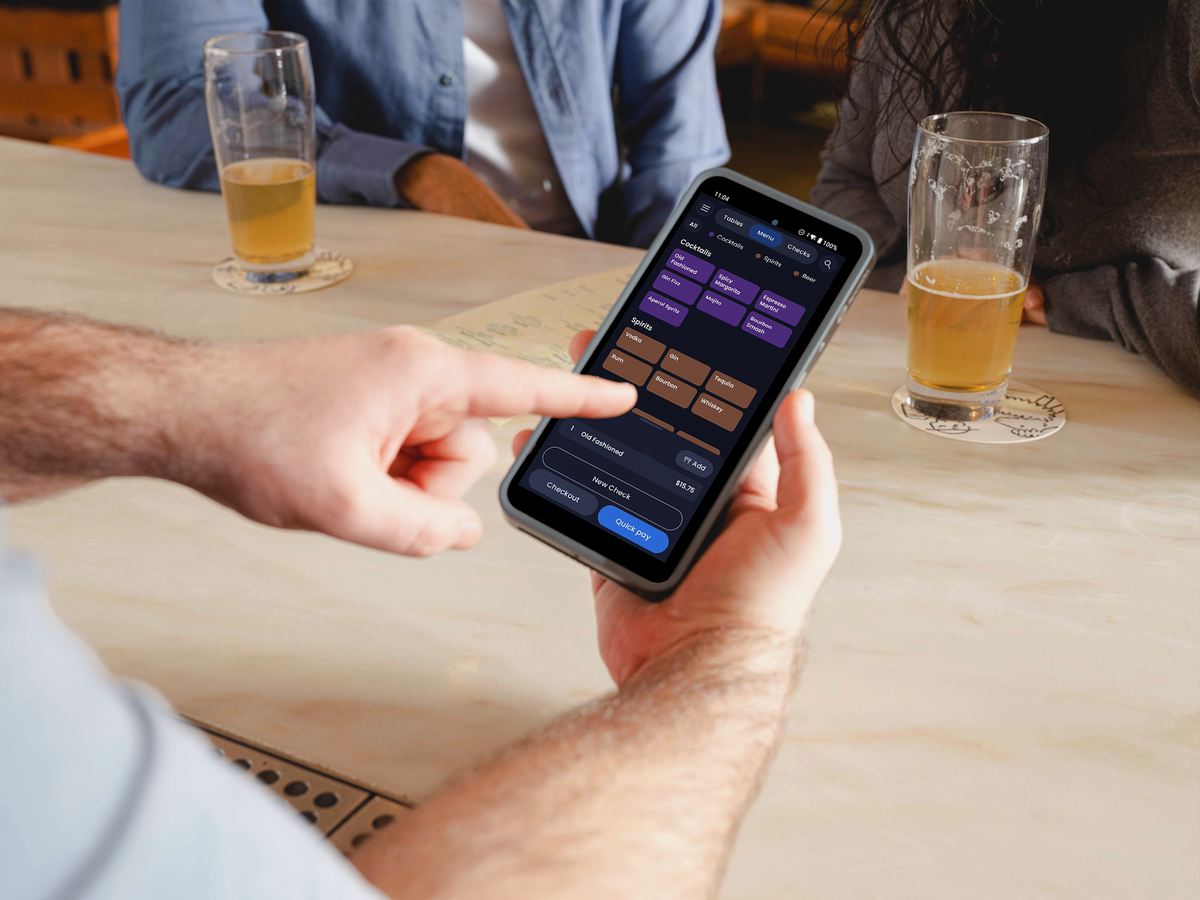
Handheld POS devices have become standard equipment in full-service restaurants, and it's not hard to see why. Tableside ordering is a must-have for restaurants looking to improve margins. Servers who can fire orders and close out checks at the table make fewer trips back to a fixed terminal, which means faster table turns and more time actually spent with guests. (For servers adjusting to the shift, our guide to working a handheld POS covers the on-the-floor habits that make the biggest difference, from firing drink orders first to using Quick Send during a slammed shift.)
But a handheld only helps if it survives the shift it's meant for. A device that dies mid-service, drops a connection on the patio, or can't take a payment when the internet blinks isn't saving anyone time, it's creating a new problem. Not every handheld on the market is built for that reality.
What to look for in a restaurant handheld POS system
A restaurant handheld POS that's actually built for restaurant use should give you:
- Drop and water resistance rated for the kind of abuse a device takes, not only out in the dining room and patios but at the bar and in the kitchen where all sorts of perils await including the dish pit
- A true offline mode that keeps taking orders and payments if Wi-Fi drops mid-rush
- Fast kitchen sync so orders hit the KDS the moment they're placed, not seconds later
- All-shift battery life that doesn't leave staff hunting for a charger at 8pm
- Full payment flexibility, including tap, dip, swipe, and mobile wallets like Apple Pay and Google Pay
- A display built for speed, with a layout servers can navigate one-handed while walking a section
If any of these are missing, the handheld becomes a workaround staff have to manage rather than a tool that speeds up their shift.
Which handheld POS system is best for restaurants?
G2's Summer 2026 Grid Report ranked SpotOn the #1 restaurant POS system overall, ahead of Toast, Clover, and Square, citing it as the best fit for growing restaurants that want flexible features without sacrificing support. However, that rating includes the overall POS system, including POS stations and handhelds, and at the end of the day the right handheld still depends on what your restaurant needs most:
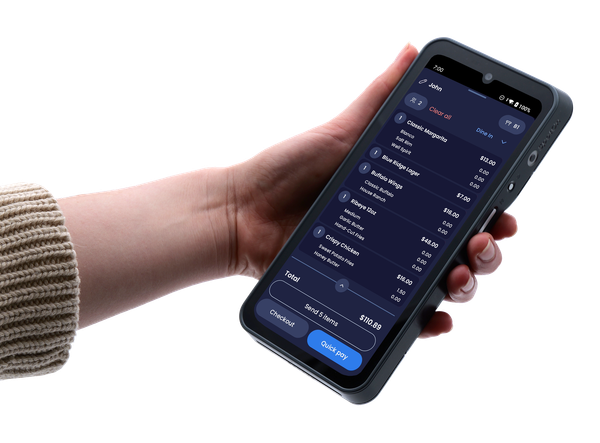
- SpotOn Handheld is the most durable handheld POS on the market for restaurants, with a 5-foot drop rating and IP67 rating. It’s also faster, easier, and more reliable than previous generations of SpotOn Handhelds.
- IP67 rated, submersible in 3 ft of water for 30 minutes
- 5 ft MIL-STD-810H drop rating, tested for the daily wear and tear in a hardworking restaurant
- Up to 18 hours of battery life, charging to 80% in 1.8 hours
- Octa-core processor with 8 GB of RAM and a 6.7" display, the biggest screen in the category
- Toast Go 2 is a common default recommendation for full-service restaurants, largely because of Toast's broad software depth, including coursing and seat-level ordering. The device itself is spill-resistant but only has an IP65 protection from dust and liquids, and Toast's offline mode is well regarded, though the handheld itself is one piece of a larger, more expensive software commitment.
- Clover Flex works across restaurant and retail settings, not just table service, and pairs with Clover's wider hardware lineup. It's a solid pick for operators who want one ecosystem spanning multiple business types rather than a restaurant-only build.
- Square Terminal is the simplest option here, and the best fit for counter-service spots and cafes rather than full table service. Flat-rate pricing makes it easy to set up, but it isn't purpose-built for tableside workflows.
Taking into consideration all these factors, SpotOn Handheld is the best handheld choice for most full-service restaurants. In addition to being the most durable handheld available, SpotOn's offline mode keeps handhelds, stations, printers, and the KDS in sync and still taking orders and payments even during an internet outage, which is exactly the moment a restaurant can least afford downtime.
That reliability changes what a shift actually looks like:
- No dead zones on the patio. Wi-Fi 6E connectivity means the handheld keeps working in the sections where signal is weakest.
- No stalled orders during an outage. Zero-disruption offline mode keeps firing tickets to the kitchen even when connectivity drops.
- No fumbling in low light. A backlit EMV reader keeps card payments fast even in a dim dining room or bar.
- No guessing on durability. A 50,000-hour MTBF backs up the "built for restaurant use" claim with a real number, on top of the drop and water ratings already covered above.
What results are restaurants seeing with handhelds?
Real clients are already seeing the payoff. At The Mudpuppy in Vonore, Tennessee, Food & Beverage Director Mark "Vegas" Bergens has seen a 35% increase in check averages and a 7% decrease in labor spend since bringing handhelds onto the floor: "Handhelds allow us to increase our average check and have fewer employees on the clock."
WATCH: How The Mudpuppy grew check sizes and Rreduced labor with SpotOn Handheld POS
At J.P. Fitzgerald's in Hamburg, New York, Owner and Operator Bob Brunner has cut wait times by half an hour while serving more guests, alongside a 20% increase in check averages.
WATCH: Faster, better service with SpotOn Handheld POS at J.P. Fitzgerald's Restaurant
And at Bocaditos Cafe in Batavia, Illinois, President and Co-owner Juliana Cancelo has increased tickets by 30 to 35% without breaking down the kitchen line.
WATCH: Bocaditos Café grows tickets 35% with SpotOn's Handheld POS System
How does the SpotOn Handheld hold up in real restaurant conditions?
The specs back up what those results suggest:
- Build: 550 nits brightness, 720 x 1600 resolution, 0.94 lb, 64 GB storage
- Payments: tap (NFC, Apple Pay, Google Pay), dip (EMV), and swipe, with PCI PTS v7 end-to-end encryption
- Extras: 13 MP rear camera for QR code scanning and digital gift cards
SpotOn Handheld is priced at $495 each, with financing available. See current pricing for full plan details, including any ongoing hardware discounts.
WATCH: SpotOn Handheld POS for Restaurants | Built for Spills. Built for Speed.
FAQ
What is a handheld POS system? A handheld POS is a portable device that lets restaurant staff take orders, process payments, and send tickets to the kitchen from anywhere on the floor, instead of relying on a fixed terminal.
How durable does a restaurant handheld need to be? Look for drop and water resistance ratings specifically, not just general "durable" marketing language. SpotOn Handheld, for example, carries an IP67 rating and a 5 ft MIL-STD-810H drop rating, tested for daily restaurant wear.
What happens if the internet goes down during service? This depends entirely on the POS provider's offline mode. Some handhelds stop functioning without connectivity. SpotOn's zero-disruption offline mode keeps handhelds, stations, and the KDS synced and operational during an outage.
Do handheld POS systems support Apple Pay and Google Pay? Yes, most current handhelds, including SpotOn, Toast Go 2, and Clover Flex, support NFC-based mobile wallet payments alongside standard chip and swipe transactions.
How long does a restaurant handheld's battery last? This varies by device. SpotOn Handheld is rated for up to 18 hours per charge and reaches 80% charge in 1.8 hours, built to outlast a full shift without a midservice charging break.
Quick answer: So, what's the best handheld POS for restaurants?
For restaurants where durability and uptime matter most, especially those with patios, bars, or unreliable internet, SpotOn Handheld is the best option, built specifically around surviving a full shift and staying operational through an outage, backed by an IP67 rating, an 18-hour battery, and zero-disruption offline mode. Toast Go 2 leads on restaurant-specific software depth, Clover Flex offers flexibility across restaurant and retail use cases, and Square Terminal fits counter-service and cafe settings best.
That's not just a spec sheet claim. In a G2 review for SpotOn, one restaurant server described what that means on the floor: the handheld lets staff ring in orders and take chip or tap payments right at the table, so they're no longer "walking back and forth" to a fixed terminal between tables.